
How to get rid of clover in your lawn
Clover moves in where a lawn is short of nitrogen, so the lasting fix is to feed the grass, not only spray the clover. Spray actively growing clover with a selective broadleaf herbicide in September or October (or April), checking the label says it’s safe on your grass. Follow up with a nitrogen feed in spring so the lawn outgrows it.
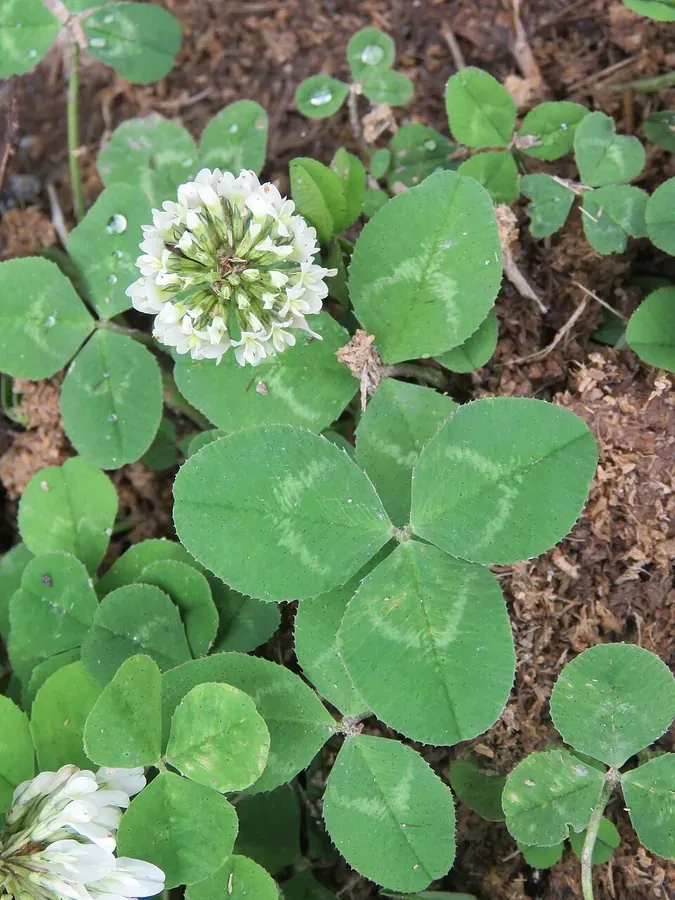
White clover. Photo: Vinayaraj, Wikimedia Commons, CC BY-SA 4.0.

Why clover wins
Section titled “Why clover wins”White clover (Trifolium repens) has three round leaflets, often with a pale band, white pom-pom flowers and creeping runners. It’s around all year but worst in spring.
Clover makes its own nitrogen with the help of bacteria in its roots. Grass can’t. So on a hungry lawn, clover stays green and spreads while the grass struggles. A patch of clover is the lawn telling you it needs feeding.
Clover isn’t all bad: it’s soft, stays green and feeds bees. But it stains clothes, attracts bees where kids play barefoot, and looks patchy in a fine lawn.
Step 1: Feed the lawn
Section titled “Step 1: Feed the lawn”- Give a slow-release granular feed with a good share of nitrogen in spring (October is ideal), and keep feeding through the growing season.
- Water it in with about 10 mm.
- Keep up the pre-winter feed in April.
A well-fed, thick lawn shades out clover seedlings and stops runners spreading.
Step 2: Spray when it’s growing
Section titled “Step 2: Spray when it’s growing”Spray in September, October or April, when the clover is actively growing and the weather is mild.
- Use a selective broadleaf herbicide that lists clover on the label.
- Check it’s safe on your grass. Some broadleaf sprays harm buffalo or kikuyu.
- Spray on a calm day under 30°C.
- Keep the lawn dry for a day afterwards, and don’t mow for a couple of days either side.
Follow the label rate and safety directions. Clover can take more than one application. Spraying the feed and the herbicide a week or two apart also works well: the feed thickens the grass, the spray clears the gaps.
Step 3: Mow a little higher
Section titled “Step 3: Mow a little higher”Clover grows low and loves sun. Raising the mowing height to the upper end of your grass’s range shades it out.
Small patches
Section titled “Small patches”Pull clover out by hand after rain, when the soil is soft, following the runners back to their roots.
With Groundsman
Section titled “With Groundsman”- On the Garden tab, open Weeds, choose In my lawn and tap the clover photo. It explains what clover says about your lawn.
- Tap I’ve got this, then Add its jobs. You get Spray clover in September, October and April, and Extra nitrogen feed (clover) in October, with rates where known. See weeds.
- Once clover (or capeweed, oxalis or flatweed) is ticked, the Weeds card warns that your lawn is short of nitrogen. Keep up the feeds in your plan; a level nearer Ideal under Plan cost feeds more often.
- When each job comes up on the Today checklist, tap How to mix and apply for amounts and sprayer fills.
- Tap Done. The feed is watered in; after the spray, scheduled watering is held. See after-care.
- In the Mowing plan, nudge Cut at up a few millimetres and tap Update my mowing jobs.
Related
Section titled “Related”Groundsman · smart watering and lawn care for Adelaide homes ·hello@groundsman.au